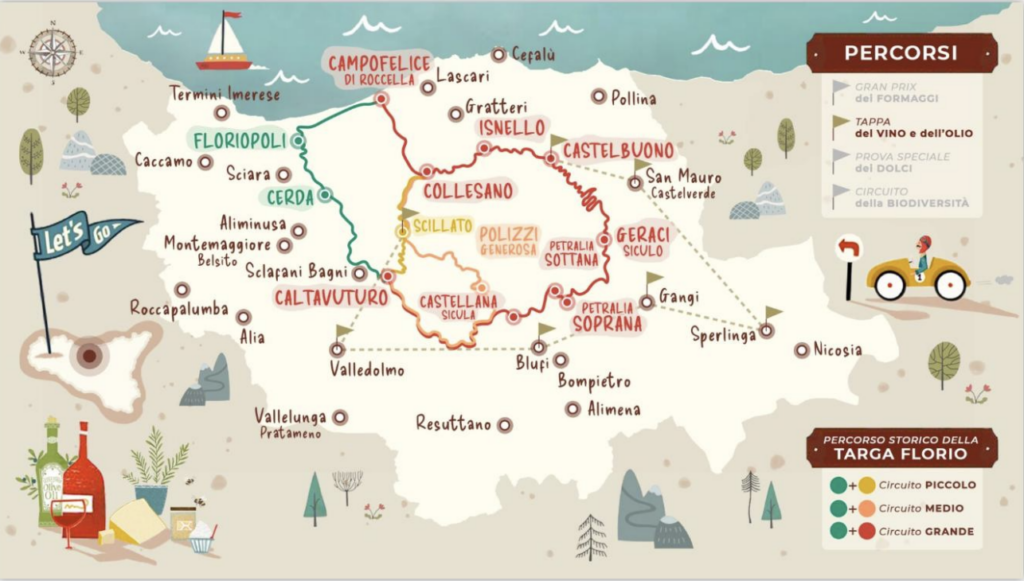
The historic Madonie Wine and Flavours Route along the Targa Florio is officially back.
After years of inactivity, one of Sicily’s most evocative wine tourism initiatives has been relaunched thanks to the commitment of local stakeholders and the support of the GAL ISC Madonie, which has identified wine and gastronomic tourism as a strategic driver for the sustainable development of the territory.
The relaunch was formally announced on 27 May 2026 at the magnificent Ventimiglia Castle in Castelbuono, where the newly elected Board of Directors met and unanimously appointed Salvatore Cicco, owner of Tenuta San Giaime in Gangi, as President of the Association, while Salvatore Burrafato, a renowned wine expert from ONAV Enna, was elected Vice-President.
From Legendary Motor Racing to a Route of Taste
The project offers a fascinating reinterpretation of one of Italy’s most legendary brands: the Targa Florio.
Rather than simply commemorating the famous motor race that made Sicily known throughout the world, the initiative seeks to transform its legacy into a contemporary tourism narrative that combines wine, gastronomy, culture, landscapes and hospitality.
The Florio name has long been associated with innovation, elegance, entrepreneurship and international vision. Today, those same values are being used to create a new experiential route across the Madonie Mountains, where visitors can discover authentic villages, family wineries, local producers, traditional recipes and cultural treasures.
The objective is clear: to transform the historic roads once travelled by racing champions into modern routes of discovery dedicated to wine lovers, food enthusiasts and cultural travellers.
A Territory United by Wine and Hospitality
Recognised by the Sicilian Region under the national legislation governing Italian Wine Routes, the association brings together a wide range of stakeholders, including:
- Wineries and wine producers
- Restaurants and hospitality businesses
- Agrifood producers
- Public institutions
- Cultural organisations
- Tourism operators
Among the members represented on the Board are some of the most important names in the Sicilian wine sector, including Castellucci Miano, Tasca d’Almerita, Abbazia Sant’Anastasia, Agriturismo Bergi, and the GAL ISC Madonie.
This broad partnership reflects a shared vision: positioning the Madonie as a destination where wine, food, nature and culture become part of a single visitor experience.
The « Routes of Taste »
A central element of the project will be the creation of a year-round programme of activities including:
- Wine tastings
- Show cooking experiences
- Educational workshops
- Gastronomic festivals
- Experiential itineraries through villages and landscapes
- Encounters with producers and artisans
The ambition is to create a genuine « Circuit of Taste » in which every village becomes a stage of a wider journey through local identity and heritage.
By encouraging visitors to travel beyond the traditional summer season, the initiative aims to contribute to the diversification of tourism flows, support local economies, promote sustainability and strengthen community participation.
A Strategic Project for the Future of the Madonie
According to Mario Cicero, President of GAL ISC Madonie, the reactivation of the Wine Route forms part of a broader strategy to revive territorial networks and cultural initiatives that had been suspended in recent years. The relaunch of the Route will soon be accompanied by the revitalisation of the regional museum network and other collaborative projects designed to reinforce local development.
For newly elected President Salvatore Cicco, the vision is particularly inspiring:
The magic of the Targa Florio should no longer race only along the dusty roads of the Madonie but continue its journey through the paths of taste, culture and hospitality, transforming a legendary motorsport heritage into a powerful engine for tourism development and territorial identity.
The rebirth of the Madonie Wine and Flavours Route demonstrates how historic narratives can be reinterpreted through wine tourism, how local communities can collaborate around a shared identity, and how wine routes can become powerful tools for sustainable territorial development.
In a region where ancient vineyards coexist with extraordinary biodiversity, medieval villages and world-famous cultural heritage, the new route offers a model of integrated tourism capable of linking wine culture with broader experiences of discovery and authenticity.
The roads that once celebrated speed and competition are now becoming routes of encounter, storytelling and hospitality—perfectly reflecting the spirit of Iter Vitis and the Cultural Routes of the Council of Europe.